Milk Foam Too Thick or Too Thin? How to Diagnose and Fix Your Microfoam
Every failed pour traces back to one of a handful of causes, and milk consistency is the biggest. The tricky part is that 'bad milk' has two opposite failure modes — too thick and too thin — and they need opposite fixes.
Apply the 'more stretching' advice to milk that's already too thick and you make it worse. So before fixing anything, diagnose which side you're on.

The Diagnosis: Watch How It Pours
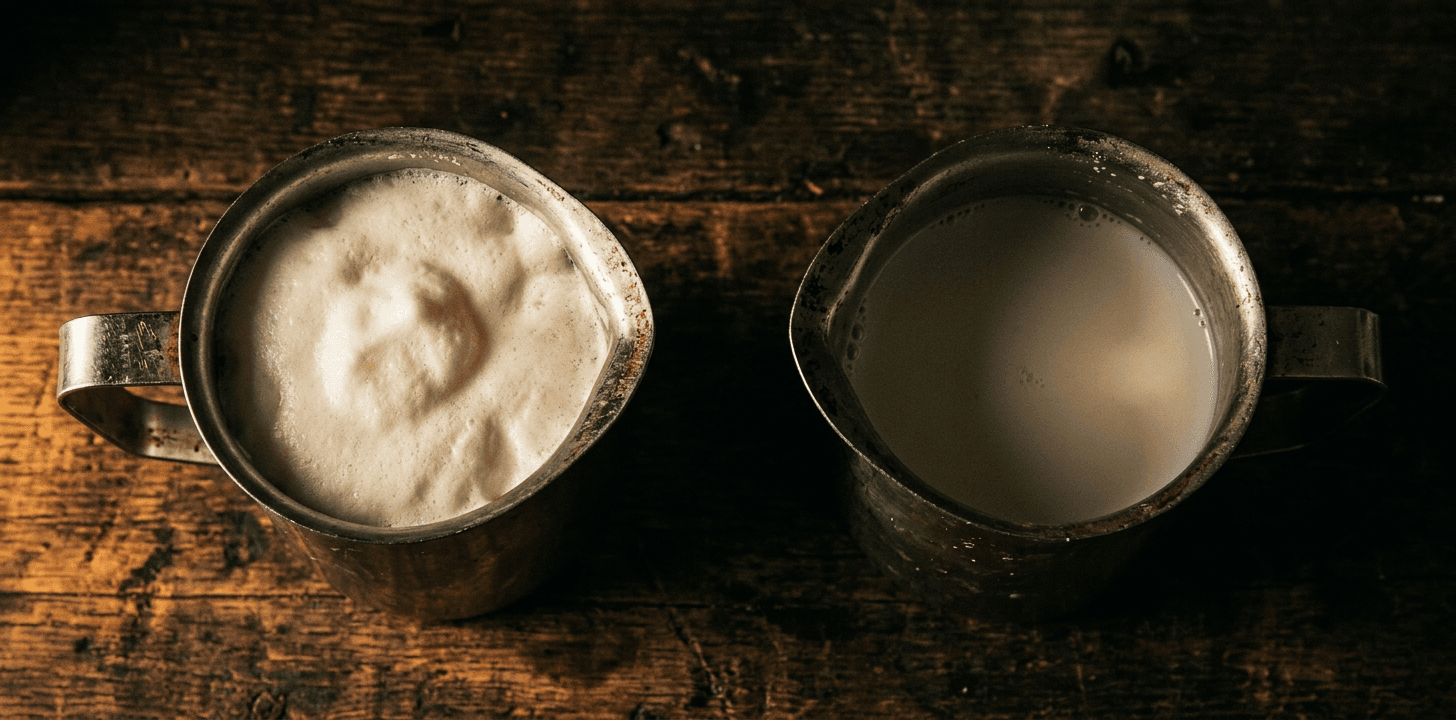
Too thick: the milk plops or folds out of the pitcher rather than flowing, sits on the espresso like a marshmallow, and the 'shape' is a puffy white mound with no crisp edges. There's often a dry, meringue-like layer on top of the pitcher.
Too thin: the milk pours like water, disappears under the crema, and no white dot ever forms. The finished drink has a thin grey surface with maybe a faint pale smear where the shape should be.
The fix: One-second test: swirl the pitcher. Milk that's right moves like wet paint — glossy, cohesive, coating the sides briefly. Foam that stays put when you tilt = too thick. Liquid that sloshes like water = too thin.
Brew · Brew calls this on every pour — the milk texture badge reads 'too thick' or 'too thin' so you know which fix to apply before your next attempt.
The Fix for Too-Thick Foam: Stretch Less, Spin More
Thick foam means too much air went in. The hissing, paper-tearing phase with the wand tip at the surface — the 'stretch' — ran too long, usually because it's the most satisfying part to hear.
Air should only be added during the first 3–5 seconds of steaming, while the milk is still cold. Everything after that is about spinning what you've got into a smooth whirlpool.
The fix: Count your stretch: two to three seconds of gentle hissing, then submerge the tip slightly and hold a fast whirlpool until you hit 60–65°C. If there's still stiff foam, you stretched too long — shorten it next time.
Brew · Puffy 3D-looking pours with low definition scores are the classic too-thick signature — Brew's feedback will point you back to the stretch phase.

The Fix for Too-Thin Milk: You Skipped the Stretch
Thin, watery milk means almost no air went in — usually from burying the wand tip too deep from the start, out of fear of making bubbles. The milk heats up but never gains the foam a shape is drawn with.
You can't pour white art with milk that has no white in it. Some stretch is mandatory.
The fix: Start with the wand tip right at the surface and deliberately let it hiss for those first three seconds. You should see the milk volume grow by 10–20%. Then submerge slightly and whirlpool to temperature as usual.
Brew · Shapes that sink or barely register — with the milk texture badge reading 'too thin' — mean the stretch phase is missing. It's the fastest milk problem to fix once named.

Stop Guessing Which Problem You Have
Too thick and too thin need opposite fixes, and misdiagnosing costs weeks of practice in the wrong direction. Brew reads the milk texture from a photo of your pour and tells you which side you're on — on every single attempt.
Try Brew free — a pour every day, no card →